CrowdStrike IDP Reliable Exam Tips, IDP Reliable Test Experience
Wiki Article
P.S. Free 2026 CrowdStrike IDP dumps are available on Google Drive shared by TrainingQuiz: https://drive.google.com/open?id=1NrNx8wrgtId-KeWEx8_I9AezG2PVB6Lj
The content system of IDP exam simulation is constructed by experts. After-sales service of our IDP study materials is also provided by professionals. If you encounter some problems when using our products, you can also get them at any time. After you choose IDP preparation questions, professional services will enable you to use it in the way that suits you best, truly making the best use of it, and bringing you the best learning results. Our IDP Study Materials have a professional attitude at the very beginning of its creation for you to get your certification.
CrowdStrike IDP Exam Syllabus Topics:
| Topic | Details |
|---|---|
| Topic 1 |
|
| Topic 2 |
|
| Topic 3 |
|
| Topic 4 |
|
| Topic 5 |
|
| Topic 6 |
|
>> CrowdStrike IDP Reliable Exam Tips <<
IDP Reliable Test Experience - IDP Actual Exam Dumps
The CrowdStrike IDP certification exam is a crucial part of career development in the tech sector. Cracking the CrowdStrike Certified Identity Specialist(CCIS) Exam (IDP) exam strengthens your chances of landing high-paying jobs and promotions. Yet, preparing for the IDP Exam can be challenging, and many working applicants struggle to find IDP practice test questions they require to be successful in their pursuit.
CrowdStrike Certified Identity Specialist(CCIS) Exam Sample Questions (Q32-Q37):
NEW QUESTION # 32
What is the purpose behind creating Policy Rules?
- A. Policy Rules determine the scope in which the sensor collects information on the environment
- B. Policy Rules determine what actions to take in response to certain triggers/conditions observed within the environment
- C. Policy Rules determine how the console tracks and learns behavior for users in the environment
- D. Policy Rules determine what actions an admin in the console can take before making adjustments
Answer: B
Explanation:
Policy Rules in Falcon Identity Protection are designed to automate enforcement and response actions based on identity-related conditions observed in the environment. According to the CCIS curriculum, Policy Rules evaluate identity signals such as authentication behavior, risk levels, privilege status, and detection outcomes, then execute predefined actions when specific criteria are met.
These actions may include blocking authentication, enforcing MFA, generating alerts, or triggering Falcon Fusion workflows. This design supports Falcon's Zero Trust and continuous validation model, where trust decisions are dynamically enforced rather than statically assigned. Policy Rules therefore act as the operational bridge between identity analytics and enforcement.
The incorrect options confuse Policy Rules with other platform components. Administrative permissions are governed by RBAC, sensor data collection scope is controlled through configuration settings, and behavioral learning is handled by Falcon's analytics engine-not Policy Rules.
The CCIS documentation explicitly defines Policy Rules as logic-based enforcement mechanisms, making Option A the correct and verified answer.
NEW QUESTION # 33
Which of the following areNOTincluded within the three-dot menu on Identity-based Detections?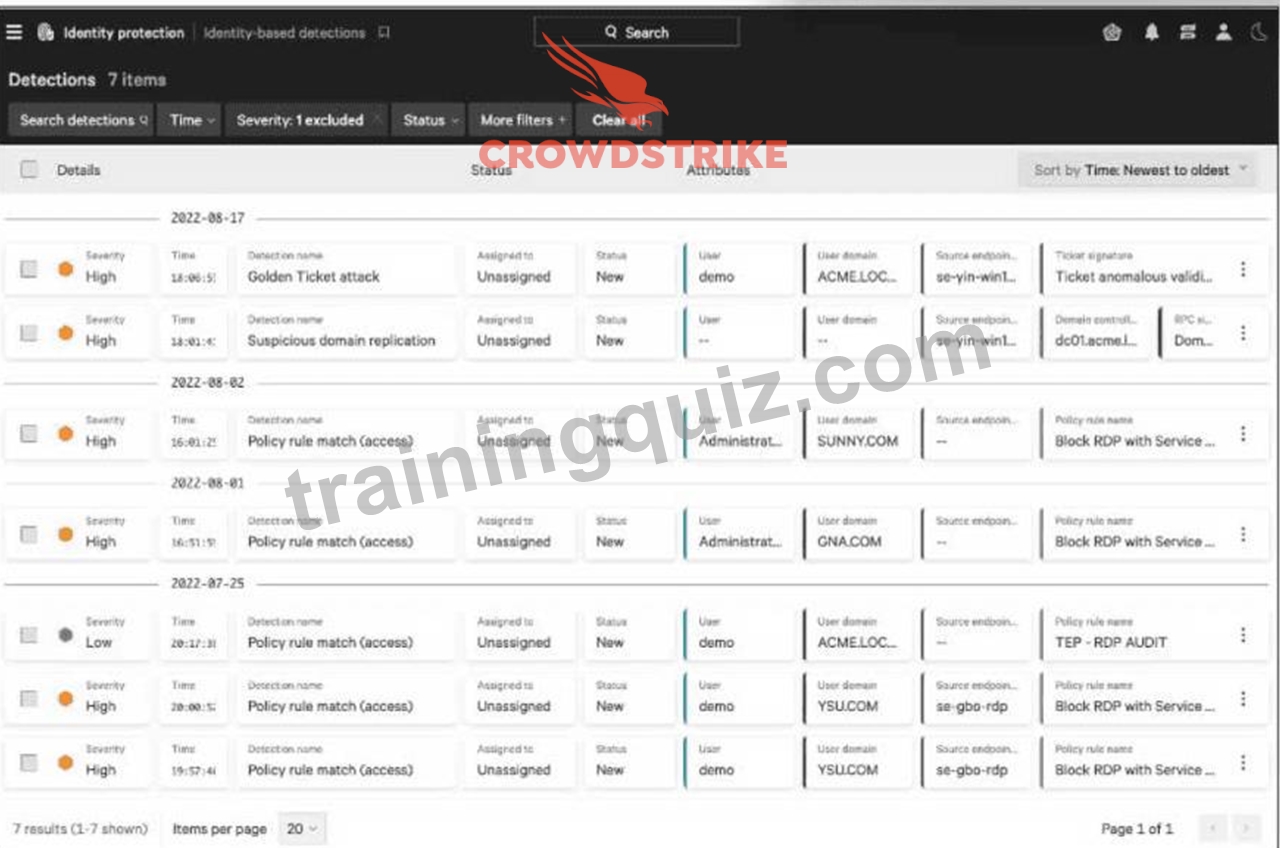
Which of the following are not included within the three-dot menu on Identity-based Detections?
- A. Add to Watchlist
- B. Add comment
- C. Add exclusion
- D. Edit status
Answer: A
Explanation:
In Falcon Identity Protection, thethree-dot (#) action menuon anidentity-based detectionprovides analysts with a limited set of actions that applydirectly to the detection itself. According to the CCIS curriculum, these actions are designed to support investigation workflow, tuning, and documentation.
The supported actions in the detection-level three-dot menu include:
* Edit status, which allows analysts to update the detection state (for example, New, In Progress, or Closed).
* Add comment, which enables collaboration and documentation directly on the detection.
* Add exclusion, where supported, to suppress future detections that match known benign behavior.
Add to Watchlistisnot includedin this menu because watchlists are applied toentities(such as users, service accounts, or endpoints), not to detections. Watchlists are managed from entity views or investigation workflows and are used to increase visibility and monitoring priority for specific identities-not to act on individual detections.
This distinction is emphasized in CCIS training to reinforce the separation betweenentity-centric actionsand detection-centric actions. Because watchlists operate at the entity level,Option Bis the correct and verified answer.
NEW QUESTION # 34
Which of the following isNOTa default insight but can be created with a custom insight?
- A. Compromised Password
- B. GPO Exposed Password
- C. Using Unmanaged Endpoints
- D. Poorly Protected Accounts with SPN
Answer: D
Explanation:
In Falcon Identity Protection,default insightsare prebuilt analytical views provided by CrowdStrike to immediately highlight common and high-impact identity risks across the environment. These default insights are automatically available in theRisk AnalysisandInsightsareas and are designed to surface well-known identity exposure patterns without requiring customization.
Examples ofdefault insightsincludeUsing Unmanaged Endpoints,GPO Exposed Password, and Compromised Password. These insights are natively provided because they represent frequent and high-risk identity attack vectors such as credential exposure, unmanaged authentication sources, and password compromise, all of which directly contribute to elevated identity risk scores.
Poorly Protected Accounts with SPN (Service Principal Name), however, isnot provided as a default insight. While Falcon Identity Protection does collect and analyze SPN-related risk signals-such as Kerberoasting exposure and weak service account protections-this specific grouping must be created by administrators usingcustom insight filters. Custom insights allow teams to define precise conditions, combine attributes (privilege level, SPN presence, password age, MFA status), and tailor risk visibility to their organization's threat model.
This distinction is emphasized in the CCIS curriculum, which explains thatcustom insights extend beyond default coverage, enabling deeper, organization-specific identity risk analysis. Therefore,Option Dis the correct answer.
NEW QUESTION # 35
How many days will an identity-based incident be suppressed if new events related to the same incident occur?
- A. 5 days
- B. 14 days
- C. 7 days
- D. 30 days
Answer: A
Explanation:
Falcon Identity Protection usesincident suppression windowsto prevent alert fatigue while still maintaining accurate incident tracking. According to the CCIS documentation, whennew events related to an existing identity-based incident occur, the incident issuppressed for 5 days.
This suppression means that Falcon does not generate a new incident for the same activity during this window. Instead, additional detections areadded to the existing incident, allowing analysts to view the full progression of the threat in a single investigative context.
The 5-day suppression window ensures that ongoing identity attacks-such as repeated authentication abuse or lateral movement-are consolidated rather than fragmented across multiple incidents. This improves investigation efficiency and aligns with Falcon's incident lifecycle management approach.
Because the suppression period is fixed at5 days,Option Dis the correct and verified answer.
NEW QUESTION # 36
Within Domain Security Overview, whatGoalincorporates all risks into one security assessment report?
- A. Privileged User Management
- B. AD Hygiene
- C. Reduce Attack Surface
- D. Pen Testing
Answer: C
Explanation:
Within the Domain Security Overview,Goalsare used to tailor how identity risks are grouped, evaluated, and reported. TheReduce Attack Surfacegoal is the only option thatincorporates all identity risks into a single, comprehensive security assessment.
The CCIS curriculum explains that Reduce Attack Surface provides a holistic view of identity exposure by aggregating risks related to authentication paths, account hygiene, privileges, misconfigurations, and legacy identity weaknesses. This goal is designed for organizations seeking an overall understanding of their identity security posture rather than focusing on a specific domain such as privileged users or directory hygiene.
Other goals are more specialized:
* AD Hygienefocuses on directory configuration issues.
* Privileged User Managementconcentrates on high-privilege identities.
* Pen Testingaligns more with adversarial simulation than continuous risk assessment.
Reduce Attack Surface aligns directly withZero Trust principles, helping organizations identify and eliminate unnecessary identity access paths. Therefore,Option Cis the correct and verified answer.
NEW QUESTION # 37
......
It is compatible with Windows computers and comes with a complete support team to manage any issues that may arise. By using the CrowdStrike Certified Identity Specialist(CCIS) Exam (IDP) practice exam software, you can reduce the risk of failing in the actual IDP Exam. So, if you're looking for a reliable and effective way to prepare for your IDP exam, TrainingQuiz is the best option.
IDP Reliable Test Experience: https://www.trainingquiz.com/IDP-practice-quiz.html
- 100% Pass 2026 CrowdStrike IDP: Authoritative CrowdStrike Certified Identity Specialist(CCIS) Exam Reliable Exam Tips ???? Easily obtain free download of [ IDP ] by searching on ➥ www.torrentvce.com ???? ????Sample IDP Exam
- Valid IDP Test Book ???? IDP New Dumps Book ???? Latest IDP Exam Registration ???? Go to website ▷ www.pdfvce.com ◁ open and search for ➤ IDP ⮘ to download for free ????IDP Reliable Exam Testking
- Get Latest CrowdStrike IDP Practice Test For Quick Preparation ???? Search for ⇛ IDP ⇚ and download exam materials for free through [ www.testkingpass.com ] ????IDP Valid Exam Bootcamp
- IDP New Dumps Book ???? IDP Latest Test Pdf ???? IDP Cert ???? Enter ➽ www.pdfvce.com ???? and search for 【 IDP 】 to download for free ✋Questions IDP Pdf
- Questions IDP Pdf ???? IDP Latest Test Pdf ➖ Reliable IDP Real Exam ⛷ Open ⏩ www.examcollectionpass.com ⏪ and search for ➤ IDP ⮘ to download exam materials for free ????Reliable IDP Real Exam
- New Launch IDP Questions [2026] - CrowdStrike IDP Exam Dumps ???? Search for ⏩ IDP ⏪ and obtain a free download on ➤ www.pdfvce.com ⮘ ????Questions IDP Pdf
- Sample IDP Exam ???? Latest IDP Exam Registration ???? IDP Online Test ???? Search for ➽ IDP ???? and download it for free immediately on ➠ www.torrentvce.com ???? ➡️IDP Online Test
- IDP Online Test ???? IDP Test Dates ???? IDP Latest Test Pdf ???? Search for [ IDP ] and easily obtain a free download on 「 www.pdfvce.com 」 ☝IDP Free Updates
- IDP Valid Exam Bootcamp ???? Questions IDP Pdf ???? Certification IDP Book Torrent ???? Easily obtain { IDP } for free download through 「 www.prepawayexam.com 」 ????IDP Reliable Dump
- Eliminates confusion while taking the CrowdStrike IDP exam ???? Open website ➥ www.pdfvce.com ???? and search for ➥ IDP ???? for free download ????IDP Reliable Dump
- IDP Test Dates ???? Exam IDP Format ???? IDP Free Updates ???? Open 「 www.easy4engine.com 」 enter ⏩ IDP ⏪ and obtain a free download ????IDP Latest Dumps Ebook
- deaconentz326669.bloggazza.com, www.stes.tyc.edu.tw, www.stes.tyc.edu.tw, socialclubfm.com, www.stes.tyc.edu.tw, www.stes.tyc.edu.tw, www.stes.tyc.edu.tw, wildbookmarks.com, zenwriting.net, www.bisound.com, Disposable vapes
What's more, part of that TrainingQuiz IDP dumps now are free: https://drive.google.com/open?id=1NrNx8wrgtId-KeWEx8_I9AezG2PVB6Lj
Report this wiki page